


Increasingly, schools are experimenting with the use of AI in the classroom. For some, this looks like teachers using generative AI to create classroom exercises and homework. For others, the focus is on using AI software to condense a student’s study time in core subjects, as recently reported by CBS News. Some schools are even trying to incorporate AI tutors and chatbots, so students can get immediate assistance when their teacher is not available.
At Fusion Academy, a school with a one-to-one student-to-teacher ratio, we believe AI in schools works best when it helps teachers personalize the curriculum for each student. It’s not a replacement for involved teachers or the human element of educating a student.
For example, when we enroll a student at Fusion Academy, our team creates a custom course content plan in Canvas, our Learning Management System, which is full of resources for the student’s classes. The teacher then curates each class individually for each student to meet their curriculum goals.
This is where AI-driven tools are most beneficial. Teachers can use AI to help them create resources like new slideshows, graphics, word problems, and more. By using AI systems to build custom course content more efficiently, teachers spend less energy locating and preparing resources for a lesson, so more of their energy can go into building a mentoring and instructional relationship with their students.
In this post, we explore how teachers at Fusion Academy use AI to create flexible, customized learning experiences. We’ll cover how personalization works at Fusion, how AI supports the human connections we make with our students, and explore some of the AI tools our teachers use. Plus, we cover frequently asked questions about AI in schools.
At Fusion, we’ve been the leader in personalized education since 1989. Now, we’re giving our teachers the latest, highest-quality AI tools to help them tailor education to the student in front of them even more effectively.
We have campuses in over 80 locations across the US, and a comprehensive online school for virtual learners. Students learn one-to-one with a curriculum personalized to their needs. We’re passionate about using technology to deliver this experience for our students. Learn more about Fusion Academy here.
AI-Powered Personalized Learning at Fusion Academy

Fusion Academy is an accredited private school for middle and high school students, focused on providing a truly personalized education. We do this with a one-to-one student-to-teacher model, in close-knit campuses that typically serve around 100 students each.
Our student-to-teacher ratio allows us to offer a level of personalization, flexibility, and individualized support far above what’s possible in a typical public school, helping each student excel in learning and personal development.
Fusion offers a comprehensive range of school programs in over 80 campuses in the US — including Arizona, Texas, Florida, and California — as well as a fully online option with Fusion Global Academy. These programs include:
- Full-time middle and high school programs, with a full catalog of over 300 courses, including college preparatory courses, honors courses, and AP® courses.
- Individual classes for credit, so students can take the class they need to help prepare them for graduation or higher education without enrolling in a full-time program.
- Tutoring and mentoring programs, including tutoring to help with executive functioning and life skills, as well as math and reading remedial programs.
This flexible, personalized approach to education has been key to Fusion’s teaching model since long before generative AI technology became mainstream, and countless students and their families have experienced the benefits. So, let’s look behind the scenes to see how Fusion personalizes education — both with and without AI.
How Fusion Academy Customizes the Learning Experience
Everything we do at Fusion is centered around a deeper understanding of a student’s background, and that begins with the admissions process. We get to know a student’s previous educational experience, including their strengths, what they enjoy learning about, their academic goals, the approaches that work for them, and any challenges in their previous school that led them to Fusion’s one-to-one, personalized model.
We start by meeting with a student and their family to talk about these themes in detail. We also conduct initial assessments, including:
- The Measures of Academy Progress (MAP): These assessments focus on a student’s understanding of core topics in math, reading, language usage, and science.
- Mindprint: This cognitive assessment gauges a student’s learning strengths and challenges. It helps teachers understand the best way to shape their approach to the individual student.
After the initial meetings, we pass the results and observations to the student’s prospective teachers. They use this information to formulate many different aspects of a student’s learning plan, including:
- The order to approach the concepts in each course, so the student builds from a firm foundation.
- The time spent on each aspect of the course, so the student can move quickly through material they find easy to grasp, and work on trickier concepts until they master them.
- The resources, practice questions, and assessments used in class are tailored to the student’s interests or reframed to help them better grasp challenging concepts.
- The class schedule. For example, students who have previously disliked a particular class might want to “get it out of the way” by scheduling it on a Monday, or students with sensory processing differences might want to schedule downtime after a class so they can decompress.
The Learning Management System, Canvas, gives our teachers and students a clear roadmap of what’s coming up in their classes.
We use Canvas to provide our teachers with an initial course plan, learning outcomes, and high-quality resources to build their classes around. For example, for an algebra teacher welcoming a new student, Canvas contains:
- E-texts from the Savaas Learning Company (formerly Pearson K12 Learning)
- Worksheets from CK-12
- Resources from Khan Academy (which we’ll discuss in more detail below).
We pride ourselves on providing resources that best fit our students’ needs, which means we frequently pull sections from multiple textbooks for a single Canvas course. We present them in manageable chunks, rather than sticking rigidly to one book for an entire course.
Once they have access to Canvas for a new course, teachers edit the lessons and content to make it truly personalized for the student in front of them. They can select from the available resources, or the teacher can branch out if they feel that a particular resource won’t serve a specific student (for example, because it has too many problems, or because the student responds better to word problems).
For example, here’s what the teacher interface in Canvas might look like for an Algebra 2 course. This interface contains a range of core and alternative resources, including the e-text, resources made by the teacher for past students, and resources shared by other teachers.

This teacher knows that their student has a particular interest in arts and crafts — they’ve mentioned that knitting and crocheting help them unwind, and they’ve spoken about the projects they’re working on at home. The teacher knows how much math is involved in creating a crochet pattern, so they decide to create a resource relating to crochet to help the student navigate a new concept in their algebra class.
The teacher opens Magic School, a Fusion-approved AI education tool that uses generative AI to create a wide range of exercises.
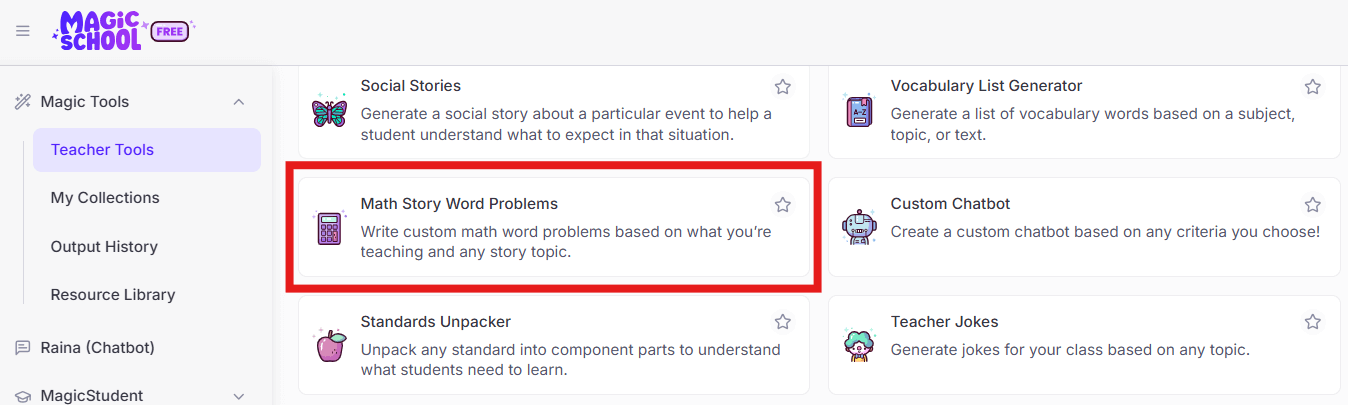
The teacher prompts Magic School with the student’s grade level, the number of questions they need, the planned learning outcomes for the lesson, and a brief description of the topic.

Magic School then generates a story problem based on that prompt. To make the resource available to the student, the teacher uploads it to Canvas and adds it to that student’s course.
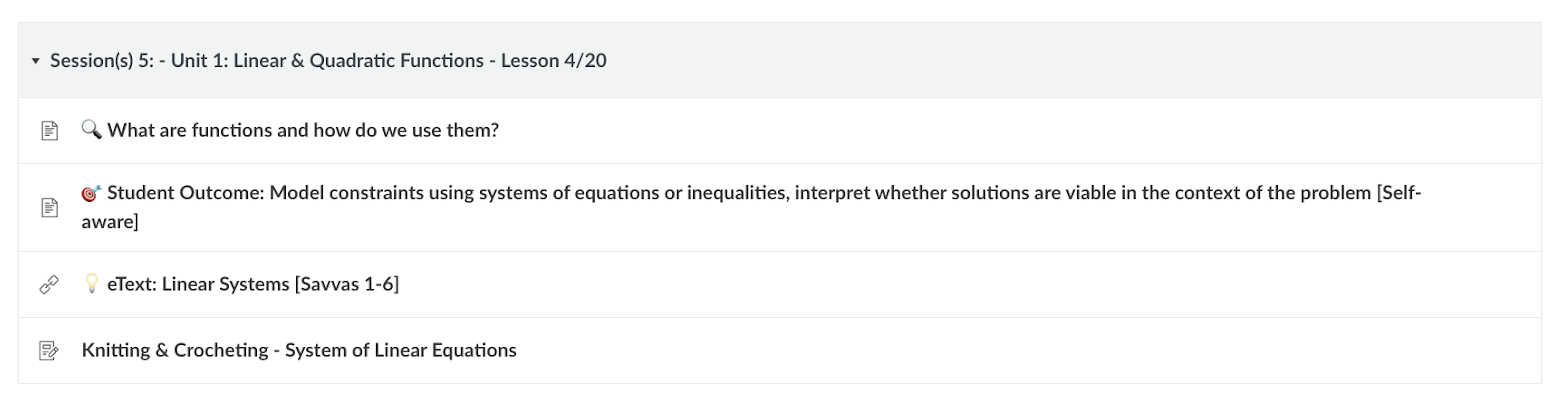
This system also means personalization is an ongoing process as the teacher works with the student and gets to know them better. Teachers can easily swap out activities as they prepare their lessons — for example, changing a written assessment to a presentation that helps a student demonstrate their knowledge, or finding an opportunity to use real objects in class rather than sticking rigidly to the exercise described in the textbook.
We want Fusion teachers to use AI when it enhances a student’s learning experience. The biggest opportunity offered by these tools is the chance for teachers to use less energy building resources and lesson plans, giving them more time to devote to:
- Personalizing high-quality learning materials that give students the tools they need to reach mastery.
- Reflecting on the student’s progress — and discussing the student with their teaching colleagues — so they can build a stronger mentoring relationship during their face-to-face time.

Put simply, we believe that when AI tools help teachers deliver a higher level of personalization, there are multi-layered benefits for the student.
When personalization is truly prioritized, students often move through material more quickly — not because speed is the goal, but because mastery comes more naturally. They gain stronger academic results by understanding concepts at a deeper level and discovering new ways to apply their knowledge. And with that clarity comes personal growth and confidence, as they begin to feel genuinely at home in their learning environment.
Love, Motivate, Teach: Relationship-First AI Schooling
As more and more “AI Schools” come online, Fusion stands out for our commitment to students’ social and emotional learning alongside their academic achievements. We’ve noticed many AI education schools seem to focus on accelerating learning above everything else, but we want to do things differently. Even when they use AI to support a student’s education, Fusion teachers are mentors first, working under a simple motto: Love, Motivate, Teach.
This relationship-first teaching philosophy remains consistent throughout a student’s time at Fusion:
- We sit down with a prospective student and their family during an initial meeting. Students need to feel safe and understood to learn, so this is an in-depth conversation about their strengths, past experiences, and personality — the exact opposite of placement by algorithm.
- We adapt a student’s schedule to their other commitments — like sports, theater, or music lessons — so they can prioritize their passions and extracurriculars.
- We commit to emotionally responsible teaching, adapting our approach to each student’s academic, social, and emotional needs. That means adjusting a planned lesson based on how a student shows up that day. If they come in full of energy, we make the learning more active; if they’re feeling drained, we slow the pace and meet them where they are.
- We make time in the Homework Café a part of each student’s schedule, so they can work collaboratively alongside their peers or access support from teachers when they have questions about their coursework.
- We foster a culture of continuous improvement, personalization, and professional development, not a one-and-done AI course plan.
Fusion campuses also offer a rich social life, with student-led clubs, field trips, volunteering opportunities, and more. This helps students build their confidence in all areas of their lives, not just in academics.

If a student comes to Fusion because they want to move through course material more quickly than they could in a traditional school, our teachers can make acceleration a key part of their strategy and use AI tools to make it happen. But more importantly, we see the student as a human being and recognize that the foundation of learning is an authentic, trusting relationship and an understanding of what motivates them.
How Fusion Teachers Choose AI Tools to Enhance Learning
Fusion Academy stands out both for the quantity and quality of resources available to our teachers. To locate, test, vet, and roll out AI tools that genuinely enhance teaching, we:
- Encourage teachers to experiment with both general and education-specific AI tools.
- Use a ticketing system to maintain and improve Canvas, where teachers can report problems or gaps in the resource bank.
- Provide an AI guide for each course in our catalog, which gives example prompts to customize the curriculum and help teachers develop their skills in prompt creation with the goal of personalizing lesson plans.
- Conduct regular feedback surveys so teachers can share their experiences and identify opportunities for new tools.
- Ask teachers to share the resources they’ve created in Canvas so they can be used and adapted again.
This strategy means we’re continually researching and testing new tools that could enhance personalization and support our school community. In our experience, the following platforms have some of the most effective features for teachers.
Magic School
Magic School is designed as an AI assistant for educators. Its generative AI speeds up the process of making lesson plans, resources, assessments, and more, and teachers can also use the communication features to help them share key information effectively.
We like the specificity of Magic School’s guided prompts. For example, if a teacher wants to generate a rubric for an assignment, they can fill out fields for grade level, point scale, and assignment description. This tool is also helpful because the resources it creates are immediately usable. Whereas a tool like OpenAI’s ChatGPT can break down a topic into bullet points and even provide a lesson plan, Magic School generates presentations and assessments that our teachers can further customize for their students.
Canva
Canva is a graphic design platform with AI image generation tools. This software helps teachers create visually appealing classroom resources more smoothly and with more creative freedom than they could in another tool.
Canva includes templates for everything from posters and reports to schedules and slides. Teachers have the option of creating a “Brand Kit,” which can support a student’s learning by giving all the resources for a certain class or topic the same visual identity. The AI image generation tools will also create visuals in the teacher’s preferred style, for example, to illustrate worksheets with the specific example they need.
Labster
We use Labster in our STEM courses to provide virtual labs focused on biology, chemistry, physics, and health sciences. The tool generates immersive lab simulations that let students explore and practice science rather than just learning from a book or a lecture. For chemistry, it also creates 3D models to bring concepts like bonds and compounds to life.
We find this tool can be particularly helpful for students who’ve come to Fusion with gaps in their learning. Labster helps teachers locate exercises that focus specifically on the material a student has missed, so they can catch up quickly. And for students with learning differences who might feel uneasy with the sensory experiences in a hands-on lab setting, Labster helps them grasp the concepts and build their confidence in a more familiar environment.
Gizmo

Gizmo is an AI study tool that creates quizzes and flashcards to help students revise the concepts they’ve studied in class. It uses AI to generate resources from websites, YouTube transcripts, PDFs, and spreadsheets. This makes it a useful tool for condensing and consolidating material covered in class, especially if a student responds well to the quickfire revision activities made possible by flashcards.
Khanmingo
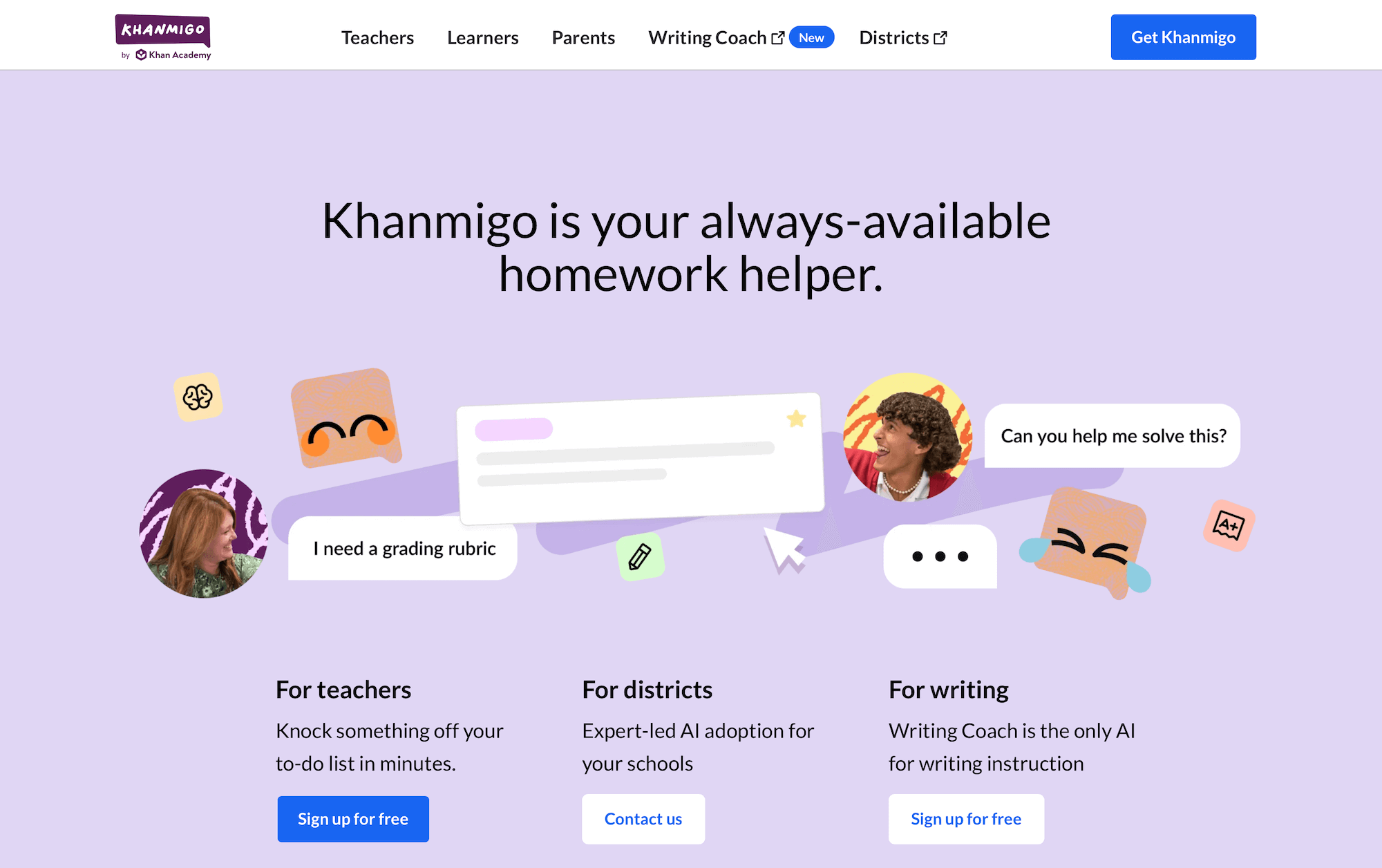
Khanmigo supports teacher workflows and works as an AI tutor to guide learners through new concepts and help them discover the answers themselves.
Khanmigo is powered by Khan Academy, a non-profit that aims to activate learning wherever a student is based in the world. They offer content for core subjects from PreK through AP level, as well as preparation materials for the SAT, LSAT, and MCAT. By using these resources, teachers can hone in on the gaps in their students’ understanding and then strategize to meet their needs.
Next Steps: Find the Best AI School for Your Child
As we’ve shown, Fusion Academy makes a wide range of tried-and-tested, high-quality AI platforms available to our teachers. Whenever an AI tool can help teachers customize their lessons to serve a student better, they can opt into those tools and share the resources they create with the rest of our school community.
AI will never replace the human connection a great teacher can make with a student, or the massive difference that connection can make to student engagement. However, these tools are here to stay, and they have the potential to lower the cognitive load for teachers. When that happens, teachers can provide a higher level of personalization (in terms of content, pacing, and assessment style) that helps students meet both their learning and personal development goals.
To learn more about personalized learning at Fusion Academy, you can:
- Request more information
- See a full list of our campuses
- View tuition and fees
- Learn about transferring to Fusion Academy
FAQ
Will AI teachers replace in-person learning?
In some cases, an AI “teacher” might help students consolidate their learning. Generative AI can break down tough concepts, create practice exercises, or provide real-world examples to show a concept in use and encourage a student’s critical thinking. However, students also need human connection to learn and grow to their full potential, and AI cannot replace that. Fusion Academy is committed to one-to-one, student-centered learning with real teachers.
What is an AI tutor?
An AI tutor is usually a chatbot that uses generative AI to check a student’s work and respond to their questions. These “tutors” use natural language AI models to recreate the experience of discussing the work with an educator face-to-face. The benefit of an AI tutor is that it’s available 24/7, so students can get instant feedback or answers to their questions about the material covered in class.
What are the benefits of AI in education?
The benefit of AI in education is that it saves teachers time, especially on administrative tasks and lesson planning. With the time they save, teachers can do more with the resources they have and spend more time customizing their lessons to meet their students’ needs.
Does Fusion Academy offer courses in AI?
Fusion Academy offers several courses in artificial intelligence to further students’ interest in computer science and promote AI literacy. For example, some Fusion locations offer middle school and high school Mini Courses in Artificial Intelligence Applications, or a STEM elective in Artificial Intelligence. In these courses, students get hands-on with AI applications. We also look at how AI is changing the internet, and we explore some big ideas and debates surrounding the future of AI.
View the full Fusion Academy course catalog for the academic year 2026/27 here.