


Choosing the right school for a child who isn’t thriving in a traditional classroom is a complex process. Some families in Texas need an alternative school because their child has a learning difference like dyslexia, ADHD, or autism. For others, it’s a child who has missed significant time in school due to illness, anxiety, or school refusal and needs a path back to full-time education that doesn’t feel overwhelming.
Some, like student actors and athletes, need a flexible schedule to balance school with their other commitments, and some families are simply looking for a school whose philosophy aligns more closely with their values than the school they’re currently in.
Texas offers a wide range of alternative schools to meet these different needs, and you’ll find especially strong options in Austin, Dallas, Houston, and San Antonio. In this article, we’ll explore some of the best options across the state, including:
- Fusion Academy, a close-knit private school with one-to-one learning and campuses in Austin, Dallas, Houston, Plano, San Antonio, Southlake, Sugar Land, and The Woodlands, plus Fusion Global Academy, our fully online option.
- Alternative schools in the Austin metro area, including the Great Minds Learning Academy for gifted students and the flagship Acton Academy main campus.
- Alternative schools in the Dallas-Fort Worth metro area, including Fairhill School for students with learning differences and the Alcuin School, which offers a combination of Montessori and IB instruction.
- Alternative schools in the Houston metro area, including The Parish School, which has an on-site pediatrics and speech-language therapy center, and The Joy School, which is set up to help students transition back into traditional school.
- Alternative schools in San Antonio, including The Winston School, a college prep school for students with learning differences, and the Montessori School of San Antonio.
Regardless of your situation or your location in Texas, this post will help you find an alternative school that meets your child’s learning needs.
What Is an Alternative School in Texas?
In Texas, “alternative school” is a broad term that covers any school that operates outside the traditional public school model.
The Texas Education Agency (TEA) recognizes several categories of alternative schooling, each with its own regulatory framework and approach to education.
- Charter schools: Publicly funded but independently operated, charter schools have more flexibility than traditional public schools in areas like curriculum design and teaching methods. They tend to work best for families who want a specific educational focus without the cost of private tuition.
- Private schools: Independently funded through tuition, private schools set their own admissions criteria and academic programs. They can be a strong fit for students who need more academic challenge, smaller class sizes, or a teaching model that a public school can’t offer (such as a starting preschool offering a Montessori education, or a high school that runs the International Baccalaureate). In Texas, private schools work with the Texas Private School Accreditation Commission (TEPSAC) and the International Association for Learner Driven Schools (IALDS) to ensure the credits a student receives can transfer easily between schools.
- Homeschooling: Legally recognized as a form of alternative education in Texas, homeschooling gives families full control over curriculum and pacing. It can work well for families who want maximum flexibility and completely personalized learning, though it requires a significant time commitment from parents.
- Online and virtual schools: Programs like the Texas Virtual School Network (TXVSN) let students complete coursework remotely either through live classes or asynchronous, self-paced work. These options suit students who live far from a suitable alternative school, need a non-traditional schedule, or would benefit from learning from home in a low-pressure environment.
- High school equivalency programs: These programs help older students who haven’t completed a traditional high school diploma pathway earn an equivalent credential, often while balancing work and other responsibilities.
It’s not unusual to explore more than one of these categories before settling on the right fit, and we’ll look at schools from many of these categories later in this post.
First, let’s look at what alternative schooling looks like at Fusion Academy schools.
Fusion Academy: Alternative Private School for Grades 4–12 in Texas
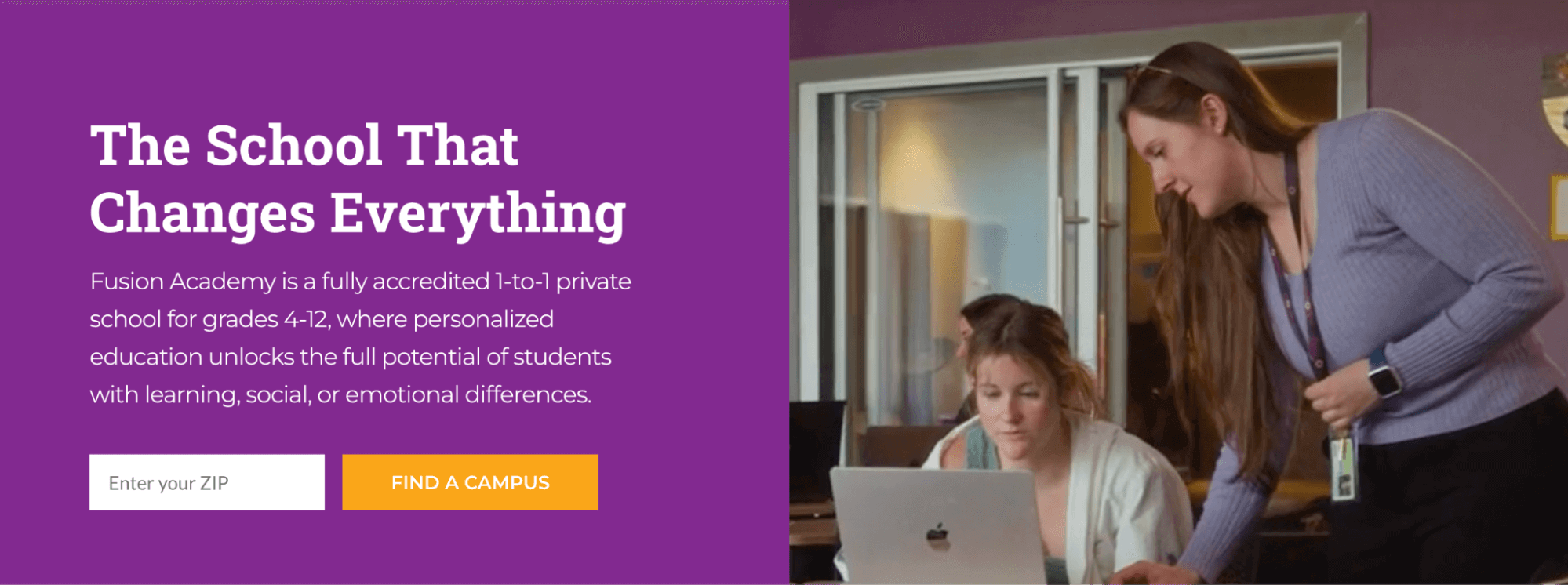
Fusion Academy is an accredited private school for grades 4–12 where students learn one-to-one or in small groups of 2–5 students. With eight campuses across Texas and a fully online option through Fusion Global Academy, Fusion offers a genuine alternative to traditional schooling, accessible to families statewide.
Fusion’s personalized approach makes it a strong fit for a wide range of students, including:
- Students with learning differences, including dyslexia and ADHD, who benefit from additional time, attention, and materials adapted to the way they learn
- Students experiencing school anxiety who need a smaller, more supportive space to feel safe enough to learn
- Students who need credit recovery or remedial support in core subjects like reading and math
- Students who need a more flexible schedule, including student athletes and performers
- Students who need additional support with executive function, organization, or emotional regulation
- Gifted and twice-exceptional (2E) students who aren’t being adequately challenged in a traditional classroom
- Homeschooling families looking for additional support in specific subjects
- Families anywhere in Texas who need online courses or a fully online learning program through Fusion Global Academy
Every family’s path to Fusion looks a little different, but what they tend to have in common is a child who needs something outside what a traditional school can offer, whether that’s more individualized attention, more flexibility, or simply a school community that better meets their learning needs.
How Fusion Academy Adapts Learning for Each Student
Personalization at Fusion starts long before a student sits down for their first class.
During the admissions process, each student and their family meet with the head of school to talk through their goals, preferences, and the past experiences that have led them to look for an alternative school.
Fusion also uses standardized assessments, including MAP® testing and the Mindprint cognitive assessment, to understand where a student is starting from and how they learn best. MAP® shows what a student has already mastered in reading, language usage, and math, while Mindprint reveals how they process information and where their strengths lie, which often explains why a capable student struggled in a setting that didn’t fit them. Together with the admissions conversations, these give teachers a foundation to build on, rather than a fixed measure of a student’s ability.
From there, personalization extends across every part of a student’s experience:
- Adaptable curriculum design and pacing. Fusion teachers use what they learn about each student to select materials that will spark their interest, adjust the pacing of the curriculum, and target any learning gaps left over from their previous school.
- Flexible lesson delivery. Because Fusion classes are taught one-to-one or in very small groups, teachers have more flexibility to adapt lessons to a student’s general preferences and to the way they show up to class on a particular day. For example, if a student needs deep concentration to work through a difficult section of a lesson, they can wear noise-cancelling headphones. If a student with ADHD needs movement breaks to focus fully, they can learn while standing up at the whiteboard or take a minute to stretch between each section of the class.
- Flexible scheduling and open enrollment. Fusion has an open enrollment policy, which means families can start at any point in the school year rather than waiting for a new semester. Students already enrolled at Fusion can also move on to new classes as soon as the previous ones are complete.
- AI-powered learning materials. We research and test the latest AI education tools to find the ones that will best help our teachers adapt their lessons to their individual students. This includes tools like ALEKS for math and Lexia PowerUp Literacy for reading, as well as Magic School for generating personalized assignments and assessments that connect new topics to a student’s interests and grade level.
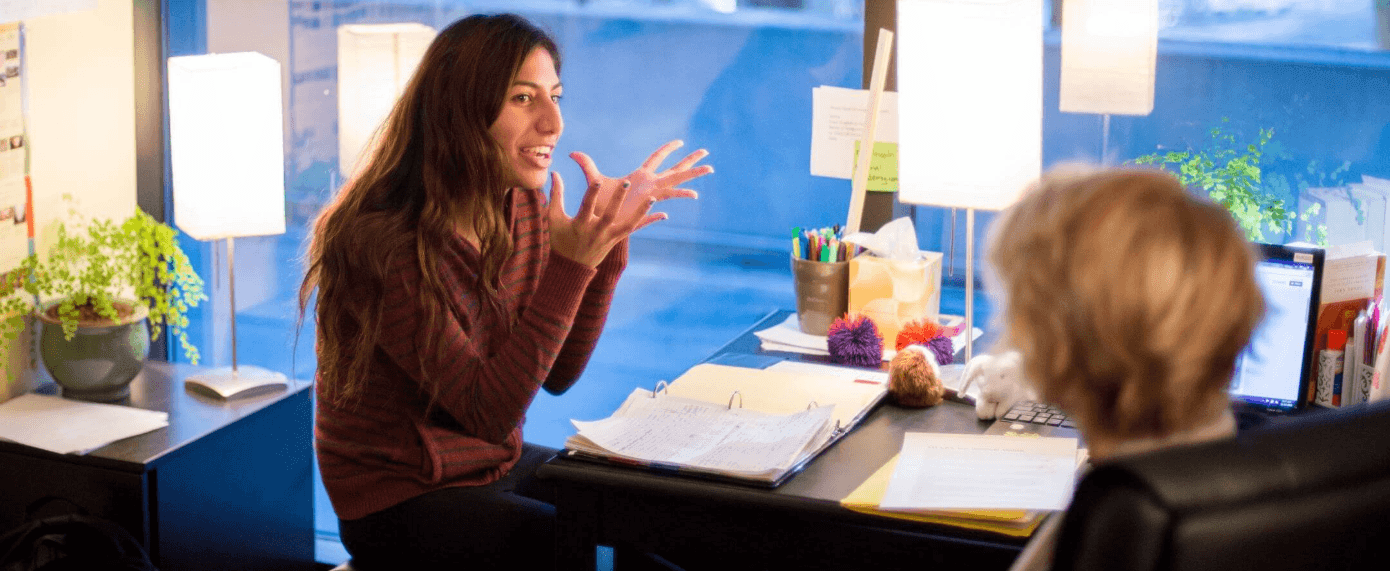
Fusion’s course catalog has over 300 options for grades 4–12. We’ve chosen every course to give our students a firm educational foundation and help them explore their skills and passions.
Fusion’s campuses in Texas offer:
- Essential courses that fulfill graduation requirements
- College preparatory and Honors courses for students who want additional academic rigor
- AP® courses for students ready to take on college-level work
- Remedial math and English programs to strengthen foundational skills
- Tutoring and mentoring adapted to a student’s individual needs
- Summer programs for credit recovery, getting ahead, or trying something new
Student Life at Fusion Academy
In our experience, when students need an alternative school, their classes are only part of the puzzle. To truly thrive, students need both a strong academic program and a school community where they feel truly seen and known.
Central to campus life at Fusion is the Homework Café, which Fusion campuses in Texas can offer in two forms:
- The Quiet Homework Café is a focused space where students can complete assignments with a teacher nearby for support. Every student has time in the Quiet Homework Café built into their schedule, which means they can finish their homework during the school day and cut down on evening stress.
- The Social Homework Café is where students eat lunch, spend time with their friends, and take part in clubs and campus events. Students can join existing clubs or suggest new ones based on their interests, with past examples including D&D, chess, and Model UN.

Fusion also runs a Community Action Program (CAP), which gives students the chance to take part in field trips, service projects, and local partnerships that build empathy and connection to the wider community.
Recent examples from Texas campuses include Fusion Academy Austin raising over $3,300 for the NAMI Walk in support of mental health, and Fusion Academy Dallas running a community kindness week to encourage students and staff to complete small acts of kindness for one another.
Students enrolled through Fusion Global Academy have access to equivalent community experiences online, including the Global Homework Café, where they can get support in subject-specific breakout rooms, and virtual clubs and events that connect our global community across campuses.
For many students, it’s this sense of belonging, alongside the academic support, that makes the biggest difference.
How Fusion Prepares Students for Life After High School
For many families considering an alternative school, the question of what comes after graduation carries real weight, because many parents worry about what a non-traditional path might mean for their child’s future options.
Fusion’s post-secondary counseling team works with students throughout their final years of high school, helping them explore the full range of available paths, including both college and alternative routes such as employment, vocational training, or transition programs.
That support includes:
- Guidance through the college application process, from tips on how to research schools and programs to interview preparation, testing support, application strategy, and help to find out about scholarships and financial aid
- Advice on gap year opportunities, including programs that align with a student’s interests and career goals
- Support comparing vocational schools and internships, with pathways in fields like skilled trades, culinary arts, and cosmetology
- Guidance on military service
- Transition planning for students with learning differences moving toward independent adulthood, connecting them with community-based support services where needed
This kind of guidance shows up in the results. According to Fusion’s 2026 Impact Report, among students from the Class of 2025 who applied to college:
- 99% of applicants were accepted to a 4-year college
- 87.5% are attending their first-choice college
- 51% received merit scholarships, with an average award of $58,303
For families weighing an alternative school against a traditional one, these outcomes speak to what’s possible when a student’s education is built around them.
Texas Private School Vouchers: Funding Your Child’s Education at Fusion Academy
If you’re still weighing the cost of an alternative school for your child, it’s worth finding out more about Texas’s Education Freedom Accounts (TEFA) program.
Created under Senate Bill 2, TEFA is a statewide private school voucher program that lets eligible families access public funding to put toward private school tuition and other approved educational expenses.
For the 2026–27 school year, the Texas Education Agency set the award at $10,474 per student, with families of children who have a qualifying IEP eligible for up to $30,000. Homeschooling families can receive $2,000 annually.
Fusion Academy’s Texas campuses can accept TEFA funds toward tuition, which helps make our unique one-to-one model more accessible for families across the state.
Find more information directly from the Texas Education Freedom Accounts website.
Fusion Academy Texas Campuses
Fusion Academy has more than 80 campuses across the U.S., including eight in Texas.
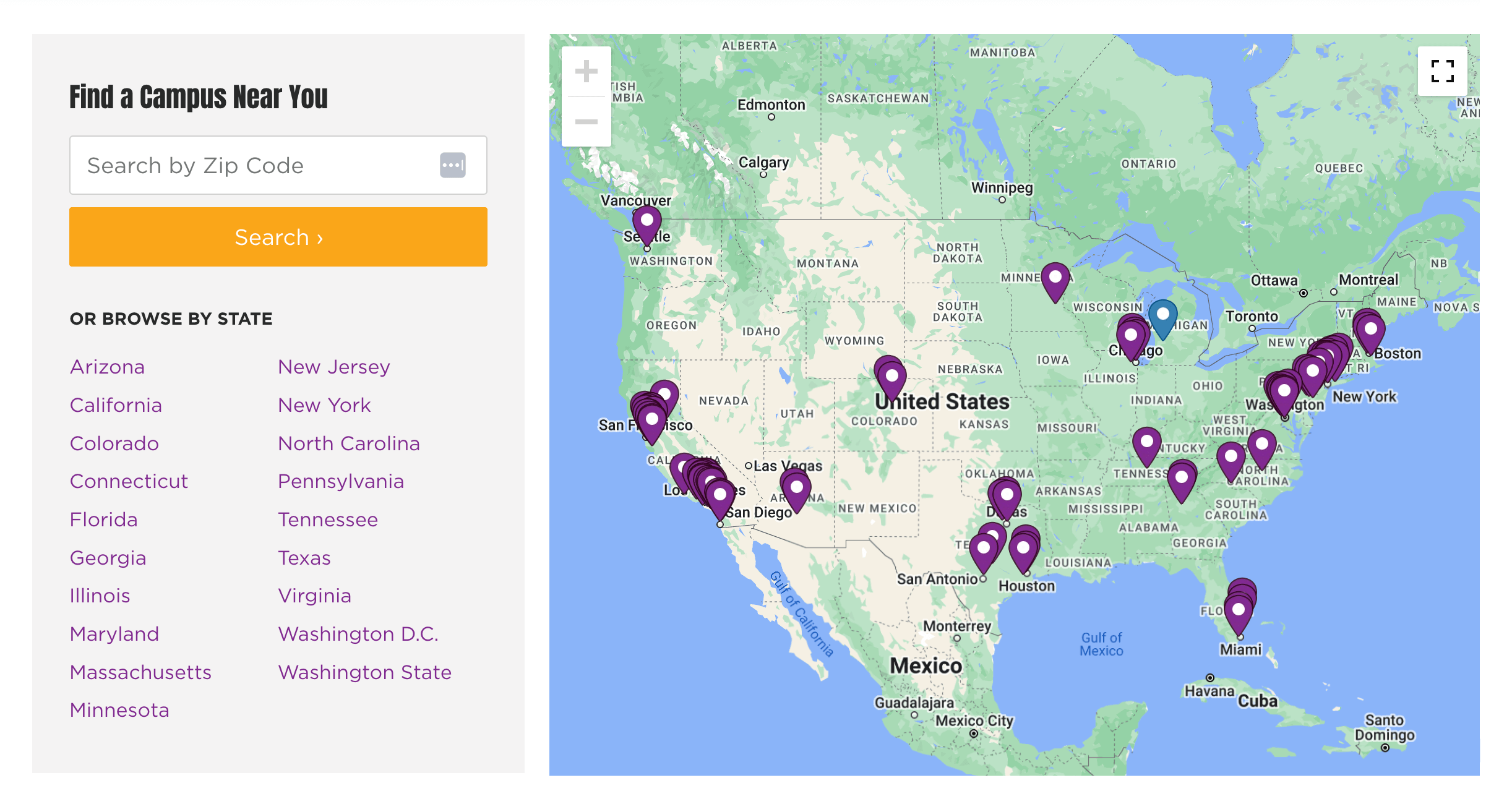
If Fusion sounds like a good fit for your child, reach out to your nearest campus directly:
| Fusion Academy Austin
4701 Bee Caves Road Phone: 512-330-0188 |
Fusion Academy Dallas
8128 Park Lane Phone: 214-363-4615 |
| Fusion Academy Houston Galleria
5065 Westheimer Road Phone: 713-963-9096 |
Fusion Academy Plano
2400 Dallas Pkwy. Phone: 972-403-9018 |
| Fusion Academy San Antonio
227 North Loop 1604 East Phone: 210-510-0203 |
Fusion Academy Southlake
301 State Street Phone: 817-416-0306 |
| Fusion Academy Sugar Land
13440 University Blvd. Phone: 281-207-9506 |
Fusion Academy The Woodlands
1201 Lake Woodlands Drive Phone: 281-419-1436 |
Families anywhere in the state can also enroll in Fusion Global Academy, Fusion’s 100% online option, through our website or by reaching out to 888-342-1861.
More Alternative Schools in Texas by City
The schools below round out the picture, covering the range of alternative school types we introduced earlier. We’ve grouped them by metro area so you can see what’s available close to home.
Austin
Great Minds Learning Community: Gifted and Twice-Exceptional Micro-School
Great Minds Learning Community is located in Pflugerville and serves grades 5–12. The school maintains a 7:1 student-teacher ratio.
What sets Great Minds apart is its student-driven, project-based model built specifically for gifted and twice-exceptional learners: students who are intellectually advanced but also navigating dyslexia, ADHD, anxiety, or sensory processing differences. Rather than requiring formal gifted or 2e testing for admission, the school leans into a “stretch zone” philosophy, letting students choose their own project topics and pace their work around their social-emotional needs as much as their academic ones.
- Address: 3400 Rowe Lane, Pflugerville, TX 78660
- Phone: 512-750-1417
Headwaters School: Montessori and IB Private School
Headwaters School is located in Austin, serving students from 18 months through grade 12 across three campuses.
Headwaters begins with a Montessori foundation and transitions into the International Baccalaureate Diploma Program by high school, a progression that’s fairly unusual to find under one roof. Beyond academics, the school builds its culture around “Peacemaker” values, with student life features like Project Week, cultural dinners, open mic poetry nights, and a Model UN program that give students room to explore identity and leadership alongside coursework.
- Address: River Campus for Middle and High School
807 Rio Grande St, Austin, TX 78701 - Phone: 512-480-8142
Griffin School: Arts-Focused College Prep High School
Griffin School is located in Austin’s Hyde Park neighborhood and serves grades 9–12. Classes are described as interactive, with an average of 12–14 students.
Griffin pairs a rigorous, AP-inclusive college prep track with one of the more serious fine arts programs among Austin’s smaller private schools. Weekly art workshops rotate through disciplines like weaving and songwriting, and students can pursue intensive coursework in creative writing, painting, and fashion, alongside full-scale theater productions.
- Address: 5001 Evans Ave, Austin, TX 78751
- Phone: 512-454-5797
Acton Academy Austin: Learner-Driven Private School
The Acton Academy Austin Main Campus is the original flagship location in the global Acton Academy network, serving ages 6–18 across its Elementary, Middle School, and Launchpad studios.
Acton’s defining feature is its “Hero’s Journey” philosophy: there are no traditional teachers, only guides who pose questions rather than give answers, and progress is measured by mastery rather than grades. Students pursue real-world Quests in entrepreneurship, science, and the arts, and are grouped by mixed age rather than grade, on the belief that children learn best working alongside those younger and older than themselves. Several other independently run Acton Academy campuses also operate around Texas, including locations in the Austin area, Dallas-Fort Worth, and Houston.
- Address: 2201 Alexander Avenue, Austin, TX 78722
- Phone:Schedule a call through the school’s site.
Austin Waldorf School: Private School with a True Waldorf Curriculum
Austin Waldorf School serves pre-K through grade 12 as the only fully accredited Waldorf program in Texas. The school has around 400 students with a student-teacher ratio of 10:1.
Set on 19 wooded acres on the edge of Hill Country, Austin Waldorf weaves crafts and artistic disciplines directly into the academic day rather than treating them as electives. Students learn woodworking, blacksmithing, and handwork alongside two foreign languages, and every student takes part in drama productions as part of the core curriculum.
- Address: 8700 South View Rd, Austin, TX 78737
- Phone: 512-288-5942
Dallas-Fort Worth Metro
Fairhill School: Private School for Students with Learning Differences
Fairhill School is located in Dallas, serving grades 1–12 with a 3:1 student-teacher ratio. It accommodates students with dyslexia, dysgraphia, dyscalculia, auditory processing disorder, and ADHD.
Founded in 1971, Fairhill’s programs go beyond core academic remediation into standout electives. Its Elementary Fine Arts program integrates music, art, and performance, and its yearbook program runs intensive hands-on workshops in design, photography, and layout, giving students with learning differences a chance to build confidence through creative work, not just academic catch-up.
- Address: 16150 Preston Rd, Dallas, TX 75248
- Phone: 972-233-1026
Alcuin School: Montessori and IB Private School
Alcuin School serves students from 18 months through grade 12. The school has around 600 students with a student-teacher ratio of roughly 8:1.
Alcuin combines a Montessori foundation with the full continuum of IB programs through to the Diploma Program in grades 11 and 12. Students take part in international travel as a core part of the IB experience, with recent trips to Iceland, Portugal, Cambodia, and Vietnam, alongside a Model UN program. The school has a dedicated performing arts center on campus, and 85% of students participate in the school’s strong athletic programs too.
- Address: 6144 Churchill Way, Dallas, TX 75230
- Phone: 972-239-1745
Fort Worth Academy of Fine Arts: Performing Arts Charter School
Fort Worth Academy of Fine Arts is a tuition-free public charter school. The middle and high school has around 400 students enrolled, with a student-teacher ratio of about 12:1.
FWAFA is home to the Grammy-winning Texas Boys Choir and gives students daily, conservatory-style training in dance, music, theater, or visual art alongside a full college-prep academic course load. Because admission is by audition, students spend their entire school day around peers equally serious about the arts, and the school reports a 100% college acceptance rate among graduates.
- Address: 3901 S Hulen St, Fort Worth, TX 76109
- Phone: 817-924-1482
Great Lakes Academy: Private School for Students with Learning Differences
Great Lakes Academy is located in Plano, serving grades 4–12 with class sizes averaging around 10 students in grades 4–8 and 12 in grades 9–12.
Great Lakes was founded specifically to serve students with ADHD and ASD Level 1 (formerly known as Asperger’s). Its curriculum includes a dedicated social skills program teaching interpersonal skills and pro-social behavior alongside standard academics, a direct response to research showing these students face disproportionately high rates of peer rejection and school discipline in traditional settings.
- Address: 6000 Custer Road, Building 7, Plano, TX 75023
- Phone: 972-517-7498ext. 100
Houston Metro
The Briarwood School: Private School for Students with Learning Differences
The Briarwood School is located in Houston, serving grades K–12 with around 300 students enrolled. This makes it one of the larger dedicated learning-difference-oriented schools in the state.
Briarwood partners with the Alley Theater, whose teaching artists collaborate directly with Briarwood faculty to run classroom experiences in comprehension, analytical writing, and performance. It’s an unusually deep community-arts partnership for a school this specialized.
Address: 12207 Whittington Dr, Houston, TX 77077
Phone: 281-493-1070
The Joy School: Private School for Students with Learning Differences
The Joy School is located in Houston, serving grades K–8 with a 4:1 student-teacher ratio.
Joy School’s stated mission is unusual among learning-difference schools. It’s explicitly designed as a transitional program, aiming to prepare students to return to mainstream classrooms rather than serve as a long-term placement. The school also leans hard into culture-building. Friday morning dance parties, themed dress-up days, and a stated goal of making school “fun” are treated as core parts of the model.
- Address: 1 Chelsea Blvd, Houston, TX 77006
- Phone: 713-523-0660
School of the Woods: College Prep Montessori School
School of the Woods is located in Houston, serving early childhood through grade 12 as the city’s oldest continuously operating Montessori school. The school has around 280 students with a student-teacher ratio of 7:1.
Students move through Lower, Middle, and High School divisions that keep building on Montessori’s self-directed, mixed-age model all the way through senior year, which is unusual since most Montessori schools stop well before high school. Families are drawn from more than 60 zip codes across greater Houston.
- Address: 1321 Wirt Rd, Houston, TX 77055
- Phone: 713-686-8811
The Parish School: Private Therapeutic School
The Parish School is located in Houston, serving pre-K–5 with a student-teacher ratio of 5:1.
Parish sits on a 17-acre, nature-based campus designed to feel like a Texas Hill Country summer camp, with an on-site pediatric therapy clinic (The Carruth Center) that integrates speech, occupational, and language therapy directly into the school day. One of its more distinctive offerings is Adventure Play, an after-school program where students build and imagine using reclaimed materials like cardboard, tires, and wood pallets in a dedicated outdoor space. It’s open to children from any school, not just Parish students.
- Address: 11001 Hammerly Blvd, Houston, TX 77043
- Phone: 713-467-4696
San Antonio
The Winston School San Antonio: Private College Prep School for Students with Learning Differences
The Winston School San Antonio serves grades K–12, with class sizes kept small through an 8:1–to 10:1 student-teacher ratio.
Since 1985, Winston San Antonio has built its reputation partly through public education. Its annual Learning Symposium draws over 300 attendees each January for talks from nationally recognized experts on learning differences, alongside four additional free seminars throughout the year for parents, educators, and healthcare professionals in the community. Academically, the school uses SIM (Strategic Instruction Model) and Orton-Gillingham-based reading programs, paired with multi-sensory teaching methods across subjects.
- Address: 8565 Ewing Halsell Drive, San Antonio, TX 78229
- Phone: 210-615-6544
The Montessori School of San Antonio: Montessori School
The Montessori School of San Antonio is located in San Antonio, serving ages 3 through 8th grade on a 24-acre campus.
MSSA is built around long, uninterrupted work periods and mixed-age classrooms in the traditional Montessori style, with a quarter-mile nature trail woven directly into the outdoor learning environment. Classrooms surround a central library and open onto gardens and patios, treating the campus itself as part of the curriculum rather than just a backdrop to it.
- Address: 17722 Rogers Ranch Pkwy, San Antonio, TX 78258
- Phone: 210-492-3553
What to Look for When Choosing an Alternative School in Texas
With so many options for alternative schools in Texas, it helps to have a framework for narrowing things down.
A few things are worth thinking through before you start touring campuses.
First, focus on your child’s specific needs, not just the type of school. Two schools can both call themselves “alternative” and have a completely different offering. A Montessori school and a therapeutic day school are both departures from the traditional classroom, but in very different ways.
Then, be clear on what’s driving the decision to change schools. Every family’s reasons look a little different. Some are responding to a specific diagnosis. Others are dealing with anxiety, school refusal, or a child who has stopped believing they can succeed academically. Understanding your child’s main obstacle in their current school will help you evaluate whether a new environment actually addresses it, and which schools could make the biggest difference.
It’s also important to think about the long term. Some families are looking for a short, intensive period of support in an alternative school before returning to a traditional school. Others want a place their child can stay through graduation. Age range matters here too, since some schools on this list serve a narrow range of grades while others can support students from elementary through high school. It’s worth having an honest conversation as a family about which of these fits your situation.
Once you’ve narrowed your list, these questions can help guide conversations with admissions teams:
- Does the school follow a specific educational philosophy or method?
- What training do teachers have for students with diverse academic and social-emotional needs?
- What is the average class size?
- What supports and accommodations are available?
- How does the school work with families and outside professionals?
- How does the school support social-emotional learning and mental health?
- What extracurricular activities are available?
- How does the school communicate with families?
- Can they share examples of students who have thrived after struggling elsewhere?
Finding the Right Alternative School for Your Child in Texas
Choosing a school for a child who hasn’t thrived in a traditional classroom is rarely simple, but Texas families have many excellent options, from Fusion Academy’s one-to-one private-school model to specialized schools built around specific learning differences, therapeutic needs, and educational philosophies across the state.
If you’re exploring an alternative school for your child, we’d love to help you find the right fit.
With eight campuses across Texas and a fully online option through Fusion Global Academy, Fusion offers personalized instruction and a supportive community for students in grades 4–12.
Contact your nearest Fusion Academy campus to learn more, or explore ourfull list of campuses to find the location closest to you.