When you’re the parent of a child who is struggling, it’s painful to watch them fall behind without the right support. And when you start looking into IEPs and 504 plans to get them the help they need, the system itself can feel like a wall of legal language, acronyms, and complex eligibility criteria.
Both IEPs (Individualized Education Programs) and 504 plans exist to help students with disabilities, including ADHD, autism, dyslexia, and other learning differences and health conditions, to access the education they need. But these programs serve different purposes, have different eligibility requirements, and offer different types of accommodations, all of which we’ll cover in this post.
Once you understand the distinctions, you’ll be in a much stronger position to decide which type of plan might be right for your child and to advocate for them through the evaluation process and in meetings with their school.
Later, we’ll also discuss the importance of individualized instruction for every student who learns differently, and show you what adapted education looks like at our private school, Fusion Academy.
Fusion Academy is a private school for grades 4–12 with 80+ campuses nationwide. We offer one-to-one and small group instruction, which can be particularly beneficial for students with learning differences.
With Fusion’s individualized model, 84% of students report feeling confident in their ability to learn course material and 90% of parents agree that Fusion partners with them to help their child. Find out more here.
IEP vs. 504 Plans: Key Similarities and Differences
IEPs and 504 plans both exist to help students with disabilities access public education, so there are a few similarities between them.
Both IEPs and 504 plans are legally binding documents that entitle a child to a free and appropriate public education (which is often referred to as FAPE) in their school district. This means public schools are obligated to implement the accommodations listed in the document (although this is not the case for private schools).
Both plans are also individualized. No two 504 plans look the same — and they shouldn’t. A plan for a student with ADHD, for example, will look very different from one designed around sensory processing needs. IEPs and 504s are created after an individual student goes through an evaluation process. The goal is to define their needs, understand what would help them access education, and ensure that the set of accommodations is described accurately in the document.
Another major similarity is that both 504 and IEP plans give parents the right to participate in their child’s education and ensure they’re receiving FAPE. For example, parents can view relevant school records, and there are formal procedures for resolving disputes with the school district if a family feels an accommodation in their child’s plan has not been implemented.
That said, there are also fundamental differences between IEPs and 504s.
First, the plans are mandated by different laws. The IEP is connected to the Individuals with Disabilities Act (known as IDEA). On the other hand, a 504 is covered by the Rehabilitation Act of 1973, which is a federal civil rights law that prohibits disability-based discrimination.
Second, the plans require schools to provide different levels of support.
A 504 plan is about removing barriers so that a student can access the same education as their peers. An IEP is about providing specialized instruction or services that meet the students’ needs. This specialized IEP instruction is on top of any other accommodations they need to access education in their school.
For example, if a student has dyslexia, a 504 plan might require a school to give them extra time when they’re taking a test, whereas an IEP might focus on the need for one-to-one reading instruction alongside assistive technology like text-to-speech software.
Another important difference is the type of student each plan serves (which we’ll discuss in more detail below). Any student with a physical or mental disability that limits their life activities could, in theory, get a 504 plan. For an IEP, students must have a disability as defined by IDEA. These include speech and language impairments, autism, developmental delays, and hearing and visual impairments.
Individualized Education Program (IEP) Explained
An IEP is a legally binding written document that provides special education services to students with one of 13 specific disability categories recognized under IDEA. To be eligible for an IEP, the student’s disability must affect their performance in school to the point that they need specialized instruction to make progress.
The IDEA categories are:
- Autism
- Deaf-blindness
- Deafness
- Emotional disturbance
- Hearing impairment
- Intellectual disabilities
- Multiple disabilities
- Orthopedic impairment
- Other health impairment
- Specific learning disability
- Speech or language impairment
- Traumatic brain injury
- Visual impairment, including blindness.
Although some learning differences—like ADHD, dyslexia, and dyscalculia—aren’t explicitly named in this list, they would fall under the categories of “other health impairment” or “specific learning disability.”
Every IEP includes a list of specific services with timelines for delivery, the accommodations the student will receive, measurable annual goals, and requirements for tracking and reporting on the student’s progress.
For example, an IEP for a student with dyscalculia might include a goal like, “By the end of the school year, the student will solve two-step word problems involving addition and subtraction with 80% accuracy across three consecutive sessions,” along with scheduled, targeted small-group math instruction.
An IEP also brings together a dedicated team that’s responsible for creating and maintaining the plan. Under IDEA, this team must include:
- The child’s parents or guardians.
- A general education teacher. If the child is already in school, this will be a teacher who regularly instructs them. If the child is in middle school or high school and works with many different teachers, only one of the teachers is required to be on the IEP team.
- A special education teacher. This teacher is often the special education teacher or service provider who works with the child. However, if the child hasn’t received special education services yet, it can be a special education teacher who would be qualified to work with a child of their age and disability profile.
- A school psychologist or other specialist qualified to interpret evaluation results.
- A representative of the school district. This is typically the school principal or assistant principal, a special education coordinator, or a school psychologist or other administrator if they have the proper qualifications and authority.
The team’s role is to draft the IEP (including setting goals and agreeing on the specific language of the document), to implement it, and to review it at least once a year to monitor the student’s progress and decide whether the accommodations and goals in the written plan are still appropriate.
For older students, it’s also important to know that an IEP can alter high school graduation requirements. Depending on the state and the student’s situation, students with IEPs may be able to earn a diploma by meeting the goals in their IEP rather than earning the same number of credits as the rest of their graduating class.
504 Plan Explained
Unlike an IEP, a 504 plan provides accommodations to students with any disability that substantially limits a major life activity. Learning, concentrating, reading, and communicating all count as major life activities, so the range of learning differences and disabilities that qualify for a 504 is much broader than an IEP.
504 plans are covered by Section 504 of the Rehabilitation Act of 1973, a civil rights law that prohibits discrimination on the basis of disability in programs that receive federal funding (like public schools). Because a 504 plan comes out of civil rights law rather than special education law, its focus is on removing barriers and providing equal access to education, not on providing specialized instruction.
Accommodations in a 504 plan are typically about making the environment or the school routine more accessible to the student. They might include:
- Extra time on quizzes and standardized tests, which can help students with dyslexia or sensory processing disorder show what they’ve learned.
- Testing in a separate, quiet room, which can help students with ADHD or anxiety focus on their assessments with less pressure.
- Tests broken into shorter sessions, which can help students with executive function challenges or physical disabilities that make it difficult to focus for extended periods.
- Use of a computer in tests and classes, which can help students with dysgraphia or other challenges with fine motor skills express their ideas without worrying about their handwriting.
- Preferential seating, which can allow students with hearing or visual impairments to sit closer to the teacher.
- Access to a calm corner or calm room, which can support students with learning differences like autism, ADHD, or anxiety, who otherwise struggle to self-regulate during the school day.
- Visual schedules or checklists, which support students with executive function challenges who need predictability and familiar cues to help manage transitions.
- Scheduled movement breaks, which can help students with ADHD focus during periods when they need to concentrate in class.
- Permission to keep water, snacks, or medication at their desk, which is important for students with, for example, type 1 diabetes.
Of course, these are just a few examples of possible accommodations, but in every case, the accommodation is designed so the student can follow the general curriculum on a level playing field with their peers.
Some schools are more likely to recommend a 504 plan than an IEP, even in situations where a child might qualify for both.
504 plans don’t require the same formal team as IEPs. The child’s parents or guardians are involved to a degree, as well as a teacher and principal, and any school nurses, counselors, and specialists a child works with (for example, an occupational therapist). But the team is defined as the “persons involved” in the child’s case, and does not have the same formal roles as an IEP team.
It also takes fewer resources to implement a 504 because the plan doesn’t include specialized instruction. The evaluation process is also typically shorter, which means the plan can usually be delivered more quickly.
This flexibility can actually benefit some families. If a child is falling behind in reading and writing, for example, getting supportive technology approved through a 504 plan in weeks rather than months can make a real difference. However, if a child needs increased specialized instruction to make progress, a 504 plan alone may not be enough.
Key Differences Between IEPs and 504 Plans
To recap, IEPs and 504 plans share the same core purpose: helping students access FAPE in their school. But the process of getting the plan and the way it changes the child’s experience in school can be very different.
The main differences between the IEP and 504 are summed up in this table:
| 504 Plan | IEP | |
|---|---|---|
| Governing law | Section 504 of the Rehabilitation Act of 1973 | Individuals with Disabilities Education Act (IDEA) |
| Primary purpose | Removes barriers so the student can access the same education as their peers. | Provides specialized instruction designed to meet the student’s unique needs, plus any accommodations required for access. |
| Eligibility | Any student with a physical or mental disability that substantially limits one or more major life activities. | The student must have a disability falling under one of 13 specific categories defined by IDEA and require specialized instruction as a result. |
| What the document includes | A list of accommodations, modifications, and services that remove barriers. | Measurable annual goals, specialized instruction, related services, accommodations, and how progress will be tracked. |
| Who creates the plan | A team that knows the student, typically including a parent, teacher, and school administrator. | A formally defined IEP team: parents, at least one general education teacher, a special education teacher, a school district representative, and someone who can interpret evaluation results. |
| Written document required? | Recommended and standard practice, but not explicitly required by federal law. | A written IEP is legally required. |
| Review frequency | Periodically reviewed, with timing varying by district, and reevaluation typically occurring every three years. | Reviewed at least once a year, with a full reevaluation at least every three years. |
| Dispute resolution | Formal grievance procedures, complaints to the Office for Civil Rights, and impartial hearings. | Detailed procedural safeguards, including mediation, due process hearings, and state complaints. |
Which Plan Is Right for Your Child?
Whether an IEP or a 504 plan is the better fit depends on your child’s diagnosis, the kinds of support they need, and what their school is already able to offer.
An IEP might be necessary when your child:
- Has already been diagnosed with a specific learning disability like autism, ADHD, or another IDEA-recognized disability
- Needs specialized instruction methods, not just accommodations
- Isn’t progressing with standard classroom instruction, even with some accommodations
- Would benefit from legally mandated progress tracking and annual goals
On the other hand, a 504 might be appropriate when your child:
- Has a medical condition, physical disability, or other impairment that affects school
- Could access the general education curriculum with accommodations
- Primarily needs equal access rather than a modified curriculum
Many parents want to know whether a student with a condition like ADHD or autism should have an IEP or a 504 plan. In practice, these conditions are the most difficult to place in one camp or another.
Both can be recognized as disabilities according to IDEA, so both would entitle a child to be evaluated for an IEP. But there’s such a wide range within both ADHD and autism that some children find the accommodations available through a 504 plan sufficient. For example, a student with ADHD might be able to thrive in class if they have access to flexible seating, which gives them the sensory input they need to stay regulated and focus on what the teacher is saying. Likewise, a student with autism might do well with noise-canceling headphones, predictable routines, and a quiet space to decompress.
In those cases, families sometimes start with a 504 plan and move toward an IEP later if their child becomes less able to cope in school.
An autistic student, for example, might manage well in elementary school with relatively light accommodations, but find the social and sensory demands of middle school much harder to navigate. At this point, an IEP with specialized instruction and social-emotional support may be the better fit.
Common Challenges with IEPs and 504 Plans
It’s important to recognize that even after families complete a long evaluation process and get a plan in place, the accommodations themselves don’t always solve the underlying problem. Some of the challenges families of children with learning differences commonly face include:
- Schools that resist providing certain services, particularly with IEPs, because of budget or staffing constraints. Getting a specific intervention written into a plan can be one challenge; ensuring it’s delivered consistently can be another.
- Students learn in group settings where true individualization is limited. An accommodation like extended test time helps, but it doesn’t change the fact that a student may be sitting in a class of 25 others where the teacher doesn’t have the time or resources to work with students individually.
- Students feeling stigmatized by being pulled out for services. Even well-intentioned interventions can make students feel different from their peers, which can affect their confidence and self-esteem.
- Plans that don’t adequately address social-emotional needs.School anxiety, social isolation, and the stress of feeling behind can all make traditional school activities difficult, regardless of what accommodations are available.
For some families, these challenges are manageable, and their child continues to make progress within their current school. For others, they’re a signal that it might be time to explore an entirely different approach to education. To learn more about the type of school that’s right for your child, you can take our free quiz.
Fusion Academy: Alternative Private School for Grades 4–12
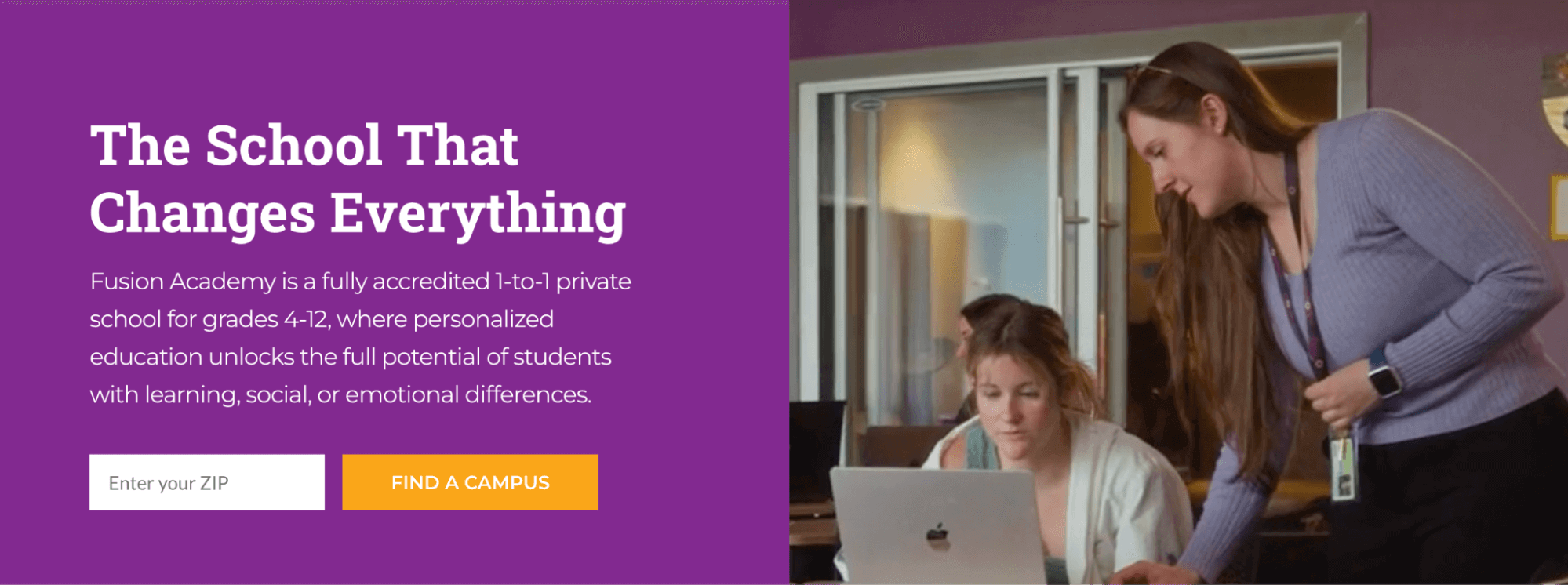
Fusion Academy is an accredited private school for students in grades 4–12, with 80+ campuses across the US and an online school, Fusion Global Academy, for students who live far from a physical campus or who need a remote learning approach.
Instead of the traditional approach to teaching, we offer one-to-one instruction or classes in small groups of 2–5 students. This means our teachers can personalize the pace, delivery, and focus of each lesson to the student or students in front of them.
Our goal at Fusion is individual education that helps every student meet their learning goals and reach their full potential.
During the admissions process, we review a prospective student’s existing IEP or 504 plan, if available, to get a sense of whether we can provide the support they need, and we work with families to get a deeper understanding of their experience of education so far. The adjustments we can make to a student’s schedule, course load, learning materials, and classroom environment may also go beyond what’s laid out in their IEP or 504, but understanding any prior documentation helps us unlock the student’s potential even faster. Through our focus on individualized learning for everyone, we are equipped to make the small changes that help students focus on their learning, grasp new concepts, and build their confidence.
We’ve found this approach can be especially helpful for students with learning differences, including:
- ADHD
- Autism
- Sensory processing disorder
- Dyslexia, dyscalculia, and dysgraphia
It can also help students with school anxiety or social struggles, who don’t fit neatly into an IDEA disability category, but whose learning and school experience can clearly be impacted.
4 Benefits of Personalized Education
Personalized education offers some specific benefits that can be difficult to replicate in a traditional classroom, even one with a strong accommodation plan in place.
For students with learning differences, those benefits often address the gaps that an IEP or 504 plan can’t fully close, like the overwhelm of learning in a large and busy group, the time it takes to adjust an approach that isn’t working, and the potential anxiety they feel about standing out from their peers.
1. Individualized Instruction
Fusion’s one-to-one teaching model gives teachers room to customize the pace, method, and content of a student’s lessons. Students dive into learning without worrying about falling behind, holding others up, or being afraid to speak up. This means that when they’re ready to tackle more challenging material, we can be sure they’re building on a strong foundation.

The personalization starts before a student’s first lesson. During the admissions process, we use MAP and Mindprint testing to understand a student’s language, math, reading, and problem-solving skills. The team also sits down with the student and family to discuss their experience of school so far, their reasons for considering Fusion, their academic strengths, and their areas of growth. That information shapes how courses are scheduled and helps us choose a mix of classes that match the student’s level.
Fusion’s full course catalog offers over 300 courses, including:
- Essential courses that fulfill high school graduation requirements
- College Preparatory courses
- Honors courses for students seeking greater academic depth
- AP® courses where students can earn college credit
Because Fusion has an open enrollment policy, students can move into the next course as soon as they finish the current one, rather than waiting for the official start of a new semester. That flexibility can make a big difference for students whose pace doesn’t match the standard school calendar. Students who need more time to consolidate a concept have the flexibility to do so, and students (such as our twice-exceptional learners) who excel in certain subjects can push ahead to more challenging material in certain classes when they’re ready.
2. Responsive Adjustments
Fusion’s teaching model is also more responsive than the models in traditional schools.
If a teacher notices that an approach isn’t working, they can try something different immediately, rather than waiting for a formal review meeting or check-in. Teachers can also adjust based on how a student shows up for class on any given day.
For example, if a teacher notices that their student seems particularly distracted, they can suggest a movement break or switch from books and worksheets to solving problems together at the whiteboard. Or, if a student has expressed anxiety around a certain topic in the past, the teacher can explore different materials and entry points that make the concept easier to engage with.

Fusion teachers also have access to the latest AI educational tools, so they can deliver a higher level of individualization without spending extra time on lesson preparation.
Programs like Magic School help teachers create custom quizzes and assignments that connect core concepts to the students’ interests and match the questions to their level.
Fusion also offers flexibility around the school day itself.
While some students prefer the standard 8:00 AM–3:00 PM schedule, others benefit from scheduling their classes later in the day, compressing their schedule into three days instead of five, or mixing in-person classes with online learning through Fusion Global Academy.
Fusion campuses are open from 7:30 AM–7:30 PM Monday–Friday, and Fusion Global Academy operates from 5:30 AM–11:30 PM ET, so families can build a schedule that fits the way their child learns best.
3. Improved Communication with Families
Fusion teachers work with far fewer students than teachers in a traditional school, as the average Fusion campus has a student body of about 100. This puts our teachers in a great position both to communicate with each other about individual students and to pass information about a student’s progress on to their family to keep them up to date daily. This helps us ensure we’re consistently meeting a student’s needs, celebrating their progress, and addressing concerns as they emerge.
Each student at Fusion also has a Lead Mentor who acts as a point of contact and an additional layer of social-emotional support for the student during the school day. For families used to the IEP or 504 systems where formal updates often happen on an annual cycle and informal updates depend on the individual teacher, this system of communication can be a huge relief.
4. Focus on Social-Emotional Learning
Fusion teachers are also mentors who believe social-emotional learning (SEL) is just as important as academics.
Alongside academic instruction, our teachers help students understand how they learn and why certain parts of school can be more difficult. They support students in building the executive function skills — like planning, prioritizing, and regulating their stress levels — that underpin their ability to learn and thrive at school.
Our teachers are also trained to connect students to peers with similar interests. This often happens in the Homework Café.

Fusion campuses have two Homework Café spaces, each supervised by a teacher:
- In the Quiet Homework Café, students can complete their assignments in a library-like setting while they’re still at school, and access help if they need it.
- In the Social Homework Café, students can work on projects together or participate in social events and clubs based on student interests, like music, D&D, debate, and fitness.
The Director of Student Life on each campus is also responsible for planning social programming for the students. This includes regular workshops that connect to SEL themes and help build community within the student body.
Fusion also has a Community Action Program that encourages students to engage with the community around their campus and to become responsible citizens. That means students help organize fundraisers, food drives, and community service each year, and engage with topics like diversity, equity, and inclusion.
For students who have previously struggled to find their place in school, our focus on social and emotional development and participation can build their confidence and help them feel like a meaningful part of the school community.
Student Success Stories
A personalized learning path can look different for every student, and success looks different too.
For some students with an IEP or 504 plan, the goal is to catch up in classes where they’ve been left behind by the standard methods of instruction. For others, it’s about protecting their mental health and self-confidence, so they can focus fully on their studies and rediscover a love of learning.
Fusion students and their families frequently describe the day they enrolled at Fusion as a turning point.
For example, Taeyu, from Fusion Seattle, said, “Now that I’m at Fusion, I realize my difficulties weren’t an issue with schooling, rather, I needed a change in environment.” Likewise, Mary, a Fusion parent, told us, “Fusion has been an absolute game changer for our son. Our only regret is not finding this incredible school sooner.”
Melia, a student from Fusion San Diego, felt isolated in her traditional high school and wasn’t able to access the support she needed. At Fusion, she was able to, in her words, “Walk out of high school with both [her] mental health thriving and a diploma in hand.” She’s now headed to UC Riverside.
And Viraj, from Fusion Newton, used text-to-speech assistive technology to earn his diploma from Fusion and earn a place at MIT. He’s set to attend the college as their first-ever non-verbal student with autism.
Across Fusion’s 2025 graduating class, the success of our learning model for every student is clear.
- 99% of Fusion graduates who applied to a four-year college were accepted
- 87.5% will be attending their first-choice school
- 41% received merit scholarships averaging $58,303
And just as important, our students grow personally and emotionally during their time at Fusion.
- 84% of parents report their child is a more confident learner since attending Fusion
- 93% of Fusion students feel listened to and treated with respect by their teachers
- 86% of students feel they were receiving the emotional support they needed after 3 months at Fusion, compared to just 48% in their previous school.
Next Steps for Parents
If your child already has an IEP or 504 plan in place and is making good progress, the most important next step is to keep advocating for them — attending review meetings, watching how accommodations are being implemented day to day, and ensuring the plan is still appropriate as your child’s needs change.
If your child is still struggling despite the accommodations their current school has in place, it may also be worth exploring alternatives.
A new learning environment can sometimes provide the kind of individual attention and flexibility that’s hard to achieve within a traditional classroom, even a well-supported one.
If you’d like to explore individualized learning at Fusion Academy, you can:
- Find your nearest Fusion campus
- Read testimonials from parents and students
- Listen to the Learning Differently podcast, where we explore the difference personalized education can make to students with learning differences
- Request more information today