When planning your student’s path to graduation from an Arizona high school, you want to be mindful of unique, state-specific requirements.
For example, Arizona high school students need 22 credits to graduate and must pass a civics test, but in other ways, students have a lot of flexibility. In Arizona, students don’t need to pass a state assessment to get their diploma. Arizona students also have flexibility in terms of where they go to school to get credits for high school graduation. Arizona has a universal ESA program, where students can receive $7,000–$8,000 each year to cover expenses like private school tuition, tutoring, and more.
Further, there are multiple paths toward graduation and college preparation. Between dual enrollment (with no credit caps), CTE certification, credit by examination, and computer science alternatives for math requirements, Arizona works to let families customize their student’s education.
We wrote this guide on Arizona high school graduation requirements to help you understand what’s required, what’s optional, and the best way for your child to get their diploma and prepare for the future.
This article covers:
- The 22-credit breakdown across subjects
- The civics test’s new 70% passing requirement
- How to use Arizona’s universal ESA program
- The different pathways available to help your student not just graduate, but thrive
Fusion Academy is a fully accredited private school with 80+ campuses, including three in Arizona. We serve students in grades 4–12, using a one-to-one learning model where students can meet all Arizona graduation requirements while receiving personalized instruction that fits their learning needs. Learn more here.
Arizona’s 22-Credit Graduation Requirements
The Arizona State Board of Education requires students to complete at least 22 credits across specific subject areas. Local school districts and charter schools may add requirements beyond this state minimum.
English: 4 Credits
Students must complete four years of English or ESL, covering:
- Literature and informational text
- Writing and research
- Speaking and listening
- Grammar and vocabulary
If your child is significantly behind in their reading and writing, a reading remediation program might help get them back on track toward graduating.
Mathematics: 4 Credits
Arizona requires four math credits, including:
- Algebra I
- Geometry
- Algebra II (or equivalent)
- A fourth course with significant mathematics content
Math courses must begin in 9th grade unless requirements are met earlier. The Algebra II requirement offers flexibility—districts can approve rigorous computer science, CTE, economics, science, or arts courses as equivalents.
If your child is significantly behind in their math education, a math remediation program might help get them back on track toward graduating.
Science: 3 Credits
Three credits of science aligned to Arizona standards and designed to prepare students for state assessments (though passing these assessments is not required for graduation).
Social Studies: 3 Credits
Social studies requirements include:
- 1 credit of American history (including Arizona history)
- 1 credit of world history or geography
- Half a credit of government
- Half a credit of economics (must include financial literacy and personal financial management)
Electives: 8 Credits
The remaining eight credits come from electives, which can include:
- Fine arts
- Career and Technical Education (CTE)
- Foreign language
- Physical education
- Other approved subjects
This significant elective requirement gives students flexibility to explore interests and develop skills beyond core academics.
The Arizona Civics Test: What You Need to Know
Every Arizona student must pass a civics test to graduate. This requirement is based on the 100 questions from the U.S. Citizenship and Immigration Services (USCIS) naturalization test.
Passing Score Requirements
Students graduating in 2026 and beyond must score 70% or higher. The previous passing score of 60% applied only through the class of 2025.
If your student already passed with a score between 60% and 69% before 2026, they’ll need to retake the test and achieve 70% to graduate in 2026 or later.
When Students Can Take the Test
Students can begin taking the civics test as early as 7th or 8th grade. There’s no limit on retakes, so students can continue testing until they achieve a passing score. The transcript shows only pass or fail, not the actual score.
Special Education Considerations
Students with Individualized Education Programs (IEPs) are only required to pass the civics test if it’s specifically included in their IEP.
Arizona Seal of Civics Literacy
Students can earn an optional Arizona Seal of Civics Literacy on their diploma and transcript by:
- Completing all social studies courses with a 3.0 or higher GPA
- Passing the civics test with 70% or higher
- Completing activities from three categories: civic learning programs, civic engagement, and written reflection
Arizona State Testing and Graduation
Here’s a crucial difference between Arizona and many other states: passing state assessments is not required for graduation.
Arizona administers:
- Arizona’s Academic Standards Assessment (AASA) for grades 3–8
- ACT Aspire for grade 9
- ACT for grade 11
While schools use these assessments to measure student learning and growth, students don’t need to pass them to receive their diploma, though they still need to take them. Local schools may establish their own academic requirements, but the state doesn’t mandate passing scores.
Academic Acceleration and Alternative Pathways
Arizona offers several ways for students to accelerate their education or meet requirements through alternative methods:
Dual Enrollment
Students can take community college or university courses that count toward both high school and college credit. Arizona doesn’t cap the number of graduation credits that can be met through dual enrollment, making this an excellent option for advanced students.
Credit by Examination
Students who can demonstrate competency in a subject can earn credit without enrolling in the course. The exam must align with Arizona’s competency requirements.
Arizona Online Instruction
Students enrolled between May 1 and July 31 do not need to provide proof of payment for online courses to have credits accepted by their school district or charter school.
AP® Courses
College-level Advanced Placement® courses allow students to earn college credit while in high school, depending on exam scores.
Career and Technical Education (CTE)
Students who complete CTE pathways can earn up to 5.5 credits toward English, math, science, and economics requirements, though restrictions apply.
Computer Science for Math Credit
With governing board approval, rigorous computer science courses can fulfill math requirements, providing another pathway for students with specific interests.
Planning for Arizona’s Public Universities
If your student plans to attend an Arizona public university (Arizona State University, University of Arizona, or Northern Arizona University), they need to meet higher requirements than the state minimum.
The Arizona Board of Regents (ABOR) requires:
- 4 years of English
- 4 years of mathematics
- 3 years of lab science
- 3 years of social studies
- 2 years of the same foreign language
- 1 year of fine arts
This totals 24 credits—two more than Arizona’s graduation minimum. Students should plan early to meet ABOR requirements if they’re considering in-state public universities.
Using Arizona’s ESA Program for Private School
Arizona’s Empowerment Scholarship Account (ESA) program provides public funding for private education, homeschooling, and educational services. As of 2022, the program is universally available, which means every Arizona K-12 student qualifies.
Who Is Eligible
All Arizona students in grades K-12 can receive ESA funding. Preschool-age children qualify if they have an IEP, 504 plan, or Multidisciplinary Education Team report. For the 2026-2027 school year, over 100k students have enrolled in Arizona’s ESA program.
How Much Funding You Receive
Most students receive approximately 90% of the state’s per-pupil base funding, which typically amounts to $7,000-$8,000 annually. Students with disabilities may receive additional funding based on their eligibility category.
Funds are distributed quarterly through ClassWallet, an online payment platform.
What ESA Funds Can Cover
Arizona ESA funds can pay for:
- Private school tuition and fees (including schools like Fusion Academy)
- Curriculum and supplementary educational materials
- Educational therapies for students with disabilities
- Tutoring services
- Educational supplies (textbooks, materials, technology)
- Home education expenses
Students must use funds to cover core subjects: reading, grammar, mathematics, social studies, and science.
Important Restrictions
Families cannot simultaneously receive ESA funding and School Tuition Organization (STO) scholarships. Students generally cannot be enrolled in public or charter schools while using ESA, with rare exceptions.
Families must submit quarterly expense reports to maintain ESA eligibility.
How Fusion Academy Helps Arizona Students Graduate
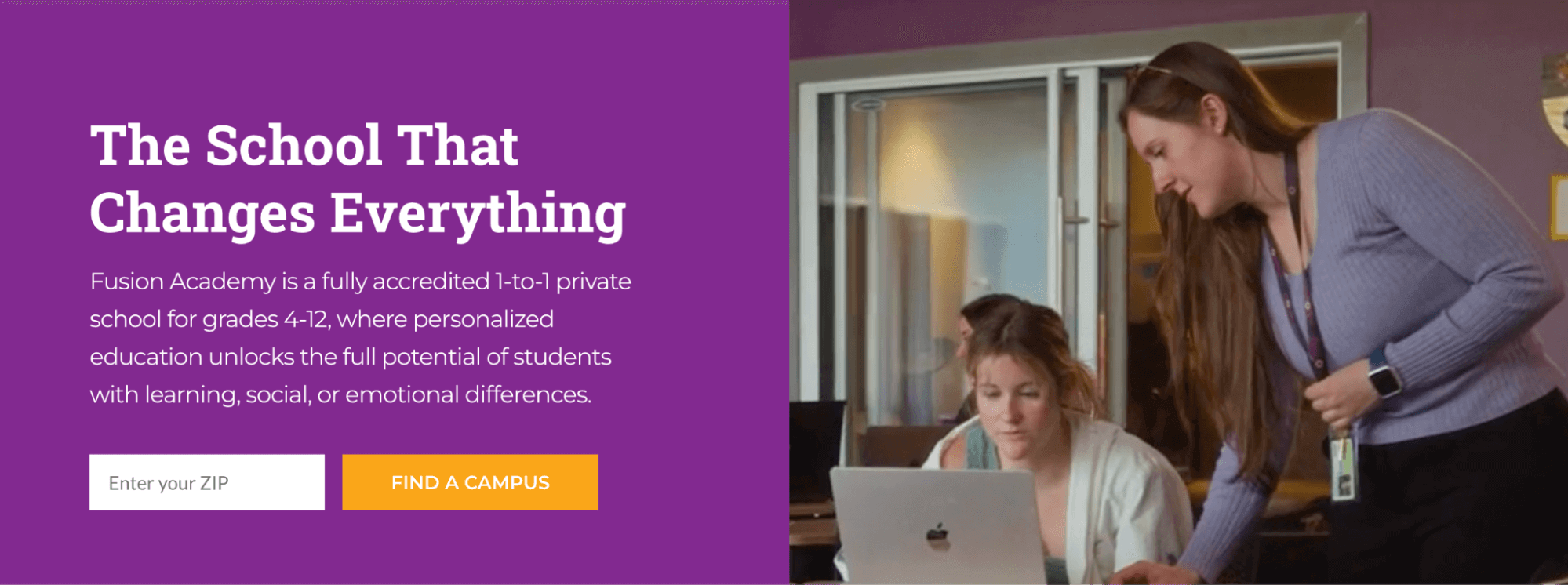
Fusion Academy is a fully accredited private school with three campuses in Arizona, including one in Gilbert, Scottsdale, and Pinnacle Peak. We serve students starting at the 4th grade level and continuing through high school graduation, with a catalog of over 300 courses. We offer full-time programs, individual classes for credit, tutoring and mentoring, and post-secondary counseling.
What makes Fusion Academy particularly effective for students navigating Arizona’s graduation requirements is our one-to-one learning model and flexible scheduling, both of which we go over in detail below.
Plus, Fusion accepts Arizona ESA and STO funding, making personalized private education more accessible to Arizona families.
If you’d like to learn more about Fusion Academy campuses and offerings in Arizona, you can reach out to us today.
Our Personalized Learning Model
At Fusion Academy, when creating your schedule, you can choose to take one-to-one classes, small-group classes, or a mixture of both. Our one-to-one classes consist of one teacher and one student, offering the highest level of personalized instruction. Our small-group classes consist of 2–5 students, so teachers can still provide personalized attention in a collaborative setting.
Our personalized approach allows us to create graduation plans that help students meet all 22-credit requirements while addressing individual learning challenges and strengths. For example, students can enroll in individual classes (to fulfill missing credits) or in a full-time high school program, earning their high school diploma from Fusion Academy.
Teachers communicate with families by email every day, sharing updates on the material covered in class, the topics that sparked a student’s interest, and their progress. This transparency helps parents stay informed and confident that their student is on track toward graduation.
Fusion Academy’s model has proven especially beneficial for:
- Students with learning differences (including ADHD, dyslexia, and autism), who benefit from a calm environment where teachers adjust pacing, integrate student interests, and apply evidence-based, multisensory strategies.
- Students with anxiety, who may have struggled in large, fast-paced classrooms and need a supportive setting to rebuild their confidence.
- Students who struggle with executive functioning, the set of skills needed to organize schoolwork, manage time, and stay on task. Fusion students can take a dedicated executive functioning skills class and receive one-to-one coaching from teachers to help them work with their brain, not against it.
- Gifted students, who can use Fusion’s personalized curriculum to move quickly through courses or dive deeper into their fields of interest.
Often, by changing the environment a student learns in, a student who previously struggled academically and socially will start to excel.
For example, Taeyu, a high school student at Fusion Academy, used to dread going to school. But when he enrolled at Fusion, he realized the issues he was experiencing weren’t due to schooling, but rather his environment.
With the support of passionate teachers and a close-knit community, Taeyu found confidence in his art, discovered a love for learning, and achieved something incredible—acceptance into Parsons School of Design with a $140K scholarship.
Taeyu is one of many student success stories. Among our 2025 graduating class:
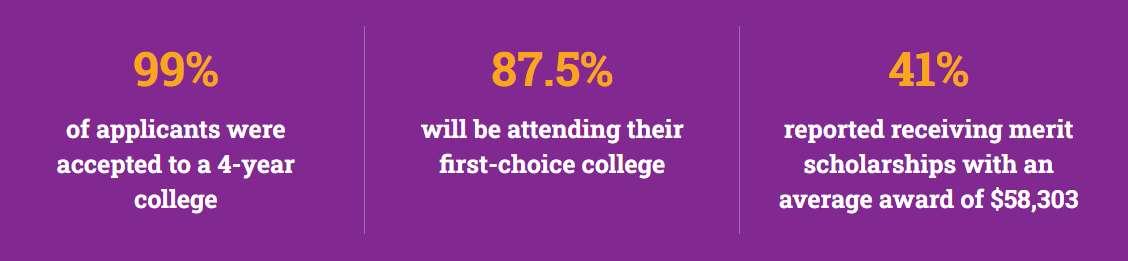
- 99% of applicants were accepted to a 4-year college
- 87.5% of Fusion students attended their first-choice college
- 41% received merit scholarships, with an average award of $58,303
Additionally, Fusion students’ achievement scores grow 39% more in reading and 40% more in math in a school year than their peers nationally, demonstrating the effectiveness of truly personalized instruction. This 41% figure is based on Fusion students’ year-over-year average MAP® growth rate compared to the average MAP growth rate of their national grade-matched peer group.
Beyond academics, 86% of Fusion students felt they were receiving the emotional support they needed, up from just 48% at their previous school, and 93% of students feel listened to and treated with respect by their teachers.
For more information on student success stories, you can read our Impact Report.
Course Options and Credit Types
Fusion offers multiple course levels to match student needs:
- Essential courses fulfill graduation requirements with additional support for students who need more scaffolding.
- College Preparatory courses provide a standard college-prep curriculum.
- Honors courses offer advanced content for students ready for additional challenges.
- AP® courses provide college-level coursework where students can earn college credit.
Students can mix course types based on their strengths. For example, a student might take an Essential English course while taking College Prep science and Honors math—creating a schedule that challenges them appropriately in each subject.
Fusion also offers Endorsements that appear on a student’s high school transcript, showing they’ve gone above and beyond general graduation requirements in a specific field of study—like STEM, World Languages, Humanities, Visual & Performing Arts, or Leadership. For students planning to attend competitive colleges, an Endorsement demonstrates dedication and depth.
Flexible Scheduling
Fusion’s campus hours run from 7:30 AM to 7:30 PM, allowing families to schedule classes around other commitments like sports, theater, medical appointments, or work schedules.
Students can attend classes full-time or part-time, and Fusion offers open enrollment year-round, so students can start at any point, not just at the beginning of a traditional semester. This is helpful for families who move mid-year, students who need to adjust their academic plan, or students who are ready to advance to their next course after mastering their current material without waiting for a new semester to begin.
Fusion’s Academic Programs for Arizona Students
Full-Time Programs
Fusion’s full-time program provides comprehensive education that meets all Arizona graduation requirements through completely personalized, one-to-one instruction. Students work with teachers who adapt each lesson to their learning needs, pace, and interests while ensuring they complete all 22 required credits.
This flexibility means a student might take an Essential math course where they need extra support while taking an AP® course in their area of strength—all while meeting Arizona’s graduation requirements.
“I spent my previous years with horrible grades, no friends, and I was just all-around sad. The minute I came to Fusion, I knew I wanted to be here. I have better grades. I met my best friend, and all of the teachers are super sweet. I don’t think I would be able to graduate without going to Fusion, and I got into my top college because of Fusion.”
– Winter H., Student
Classes for Credit
For students who only need a few specific courses to meet Arizona’s graduation requirements, Fusion offers individual classes for credit. This is ideal for students who need to:
- Make up credits in courses they previously failed or struggled with
- Retake a course to improve their GPA or better prepare for college
- Get ahead in specific subjects or complete requirements early
- Supplement their current school’s offerings
The key advantage: students can take just the classes they need while staying enrolled in their current school. A student might attend their regular high school for most courses while taking Algebra II at Fusion in the evening or during a free period.
Tutoring and Remediation Programs
Students who are significantly behind in their studies can access specialized tutoring and remediation programs designed to help them catch up while still meeting Arizona’s graduation requirements. The term “remediation” often has a negative connotation, but in our experience, these programs are a turning point for students and give them the skills they need to meet their learning goals across their different courses. Our one-to-one model allows teachers to identify exactly where students are struggling and implement evidence-based strategies to address learning gaps.
Fusion offers:
- Subject-specific tutoring in areas like algebra, chemistry, English, geography, history, and physics
- A math remediation program that supplements a student’s regular math class with direct instruction from a Fusion teacher and the ALEKS online math skills platform.
- A reading remediation programthat uses hybrid, evidence-based methods—including one-to-one teacher support paired with the Lexia PowerUp Literacy platform—to improve reading skills and comprehension. Fusion offers two tiers: the Reading Skills and Strategies program (for students between the 15th and 40th percentiles) and the Structured Literacy program (for students at the 15th percentile or below, currently in pilot at around 30 Fusion campuses).
- Executive functioning tutoring that helps students develop better study habits, organizational skills, and self-regulation strategies
In these remediation programs, students attend two classes per week either at a Fusion campus or online, and generally need to spend 30 hours in classes to complete a course successfully.
“Before I came to Fusion, I felt defeated and drained of trying in school. Nothing was working, and I was depressed and unmotivated constantly. When I came to Fusion, I found both an academically and emotionally supportive environment for the first time in my life. I was in 10th grade, and for the first time, I felt what it was like to thrive and be proud of who I had become. I give a large part of that credit to Fusion for fostering that strength and journey.”
– Ginger O., Student
Post-Secondary Counseling Services
For Arizona families investing in private education, college outcomes matter. Fusion Academy provides comprehensive post-secondary counseling that not only helps students meet graduation requirements but also positions them competitively for their next steps.
Full-time Fusion students* receive a 30-minute complimentary advising session with our counselors who help with:
- Course selection that meets both Arizona graduation requirements and college admission expectations (including ABOR requirements for Arizona public universities)
- Post-secondary planning and timeline review
- Resume creation and building
- SAT/ACT testing timeline and planning
- Scholarship and financial aid applications
- College application review and completion
- Interview preparation
Fusion students have gained admission to top universities including Stanford, Northwestern, Vanderbilt, and Georgetown, proving that personalized education prepares students for competitive college programs.
But we know that not every student follows a conventional college trajectory. Fusion counselors also provide guidance for alternative post-secondary paths, including gap years, vocational schools, military service, and transition programs for students with disabilities. This ensures every student receives appropriate guidance for their individual post-graduation goals.
* Additional advising sessions can also be purchased separately for non-full-time students.
Online Learning Options
Through Fusion Global Academy, our fully accredited private online middle school and high school, Arizona students can meet all graduation requirements entirely online while maintaining the same one-to-one personalized instruction available at our physical campuses. This is ideal for students who need geographic flexibility, have medical considerations, prefer learning from home, or are simply based further from our Arizona campuses in Gilbert and Scottsdale.
Online classes can be scheduled between 5:30 AM and 11:30 PM Eastern Time, providing even greater flexibility than our physical campuses. Students work one-to-one with certified teachers via video conferencing, using interactive tools and adapted materials designed for their specific learning needs.
Students can also create hybrid schedules that combine in-person classes at a Fusion campus with online classes through Fusion Global Academy. For example, a student might take their science class with hands-on labs at a Fusion campus while completing their English and history courses online.
Campus Life and Socialization
Fusion campuses maintain small enrollments—typically around 100 students—that create tight-knit communities. As of right now, the Gilbert campus has a little under 100 full-time students, and the Scottsdale campus has slightly more than 100 full-time students. This creates a close-knit environment where students can find their place more easily than in a busy traditional school.
“Fusion is a school I didn’t think could exist. I am so very thankful that our child loves it there, and we do too. I can’t imagine a more perfect place for high school.”
– Tracy B., Parent
Students socialize through:
- The Quiet Homework Café, where students complete assignments in a calm setting with support from teachers. Every Fusion student has scheduled time here as part of their weekly schedule, so schoolwork doesn’t have to go home.
- The Social Homework Café, where students eat lunch together, participate in clubs, connect with peers, and attend weekly student meetings. Teachers are on hand to help introduce students with similar interests to one another.
- Student-driven clubs based on student interests. At the Scottsdale campus, current clubs include improv, board games, music, video games, and D&D. Clubs vary by campus and are often student-led, encouraging students to take on leadership roles.
- Community service projects through the Community Action Program (CAP). For example, Scottsdale students recently partnered with the Foster Alliance to collect donations for a holiday toy drive.
- Educational field trips that bring learning to life. Arizona students have recently attended spring training baseball games and visited the interactive Wonderspaces art exhibition in Scottsdale.
- Campus events and celebrations throughout the year, including social meetups and seasonal activities.
Fusion Academy Arizona Locations
When you’re searching for the best high school for your child, Fusion Academy operates three campuses in Arizona: two in Scottsdale and one in Gilbert. Both campuses are fully accredited and accept Arizona ESA funding and STO scholarships, making Fusion’s personalized education accessible to Arizona families through the state’s universal school choice program.
- Fusion Academy Scottsdale: Serving grades 4–12
- Address: 8700 N Gainey Center Dr, Suite 150, Scottsdale, AZ 85258
- Phone: 602-661-3721
- Fusion Academy Gilbert: Serving grades 4–12
- Address: 400 E. Rivulon Boulevard, Suite 113, Gilbert, AZ 85297
- Phone: 602-854-6677
- Fusion Academy Pinnacle Peak: Serving grades 4–12
- Address: 7669 E Pinnacle Peak Rd, Suite 150, Scottsdale, AZ 85255
- Phone: 480-856-6650
Next Steps: Planning Your Student’s Graduation Path
Understanding Arizona’s requirements early helps ensure your student stays on track. Here’s how to plan:
- Review your student’s current progress. Check their transcript to see which credits they’ve completed and what remains.
- Understand which requirements apply. If your student plans to attend an Arizona public university, they need 24 credits meeting ABOR requirements, not just the 22-credit state minimum.
- Prepare for the civics test. If your student hasn’t taken it yet, plan for them to test before graduation. Remember the 70% requirement for classes graduating 2026 and beyond.
- Consider your student’s learning needs. If they struggle in traditional settings, one-to-one instruction might help them succeed. Students with learning differences often thrive with personalized attention.
- Explore ESA eligibility. Since all Arizona students qualify, calculate how ESA funding could support private education, tutoring, or educational materials.
- Plan for acceleration if needed. Dual enrollment, credit by examination, and summer courses can help students who need to catch up or get ahead.
Arizona’s flexibility—including universal ESA access, no required state test scores for graduation, and multiple pathway options—means families can personalize their student’s education to fit their needs.
To see how Fusion Academy can help your child graduate high school, contact us today.